

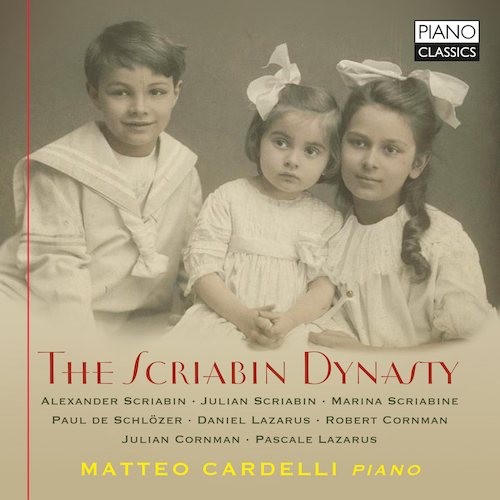
The Scriabin Dynasty - A musical family history
Piano Classics in September
An illuminating introduction to the musical riches of the wider Scriabin family, presenting many unfamiliar names and unknown pieces within the rich lineage of the Russian piano tradition.
The chronologically arranged programme begins with early works by Alexander Scriabin (1872–1915), one of the most important and distinctive Russian composers and pianists at the turn of the 20th century. His highly individual musical language developed from the late-Romantic piano tradition towards an increasingly bold and harmonically free style.
The early works featured in the programme include two fugues and a Fantasy in A minor. A particular discovery is the little-known Symphonic Allegro of 1896, possibly conceived as the first movement of a never-completed symphony and later transcribed for piano by Leonid Sabaneyev.
Scriabin’s son Julian, born in 1908, also showed exceptional talent, but drowned at the age of just eleven. The few surviving compositions are remarkable for their maturity and evoke the sound world of his father’s later works. His sister Marina Scriabine (1911–1998), by contrast, took a very different path with her atonal variations composed in the 1940s.
The family’s musical story continues across several generations: Scriabin’s grandson Daniel Lazarus draws on stylistic influences ranging from Schubert to Prokofiev in his Six Pieces. Robert Cornman, who married one of Scriabin’s granddaughters, is represented by his Sonata brevis, while his son and Scriabin’s great-grandson Julian Cornman offers a Neo-Baroque perspective on musical history in his Rondeau.
In this way, pianist Matteo Cardelli takes the listener on a journey through 150 years of musical history surrounding the extended Scriabin family – from the Romantic piano tradition inspired by Liszt, through the musical transformations of the 20th century, to the present day.